Anbernic
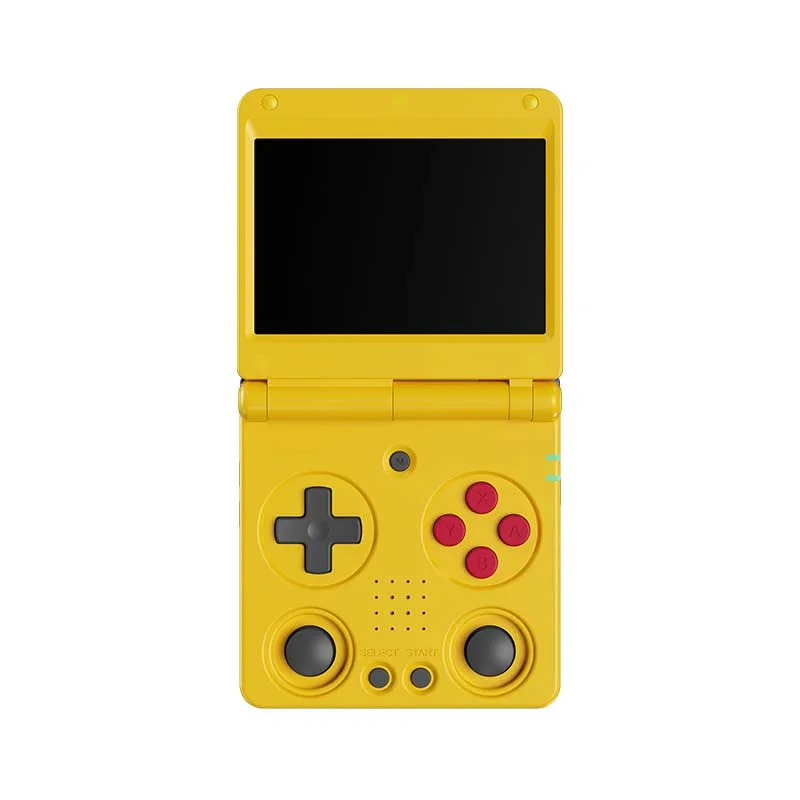
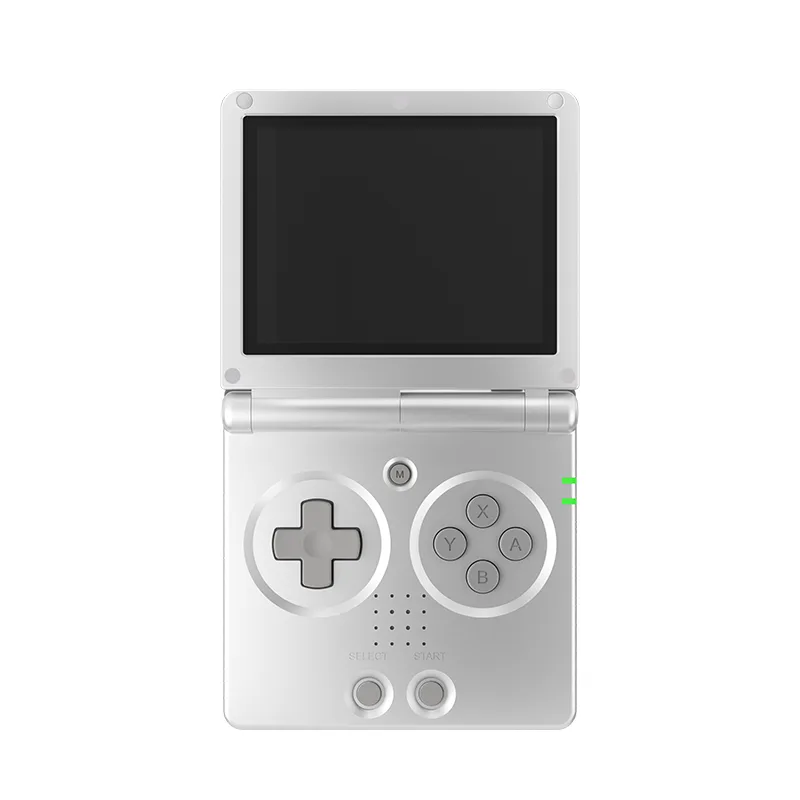
Anbernic RG35XX SP
3.5 in IPS, full viewing angle, OCA full lamination · 3300 mAh · Linux 64-bit
UK price not checked
Four folding retro handhelds confirmed by their makers' pages, plus two flip-style names we could not confirm, compared from stated specs only.
By Sepehr Sabbagh-pourPublished 14 Oct 2026Updated 9 Nov 20267 min read
Four catalogue handhelds have a maker page that says they fold: the Anbernic RG35XX SP, RG34XXSP and RG DS, and the Miyoo Flip V2. The RG34XXSP is the lightest with a stated weight, at 178 g. Picks use maker-stated specs only, and none was handled by us.
This guide is for anyone who wants a device that closes like a Game Boy Advance SP, so the screen is protected in a bag. We pick from maker-stated specs only, as explained on how we research.
A clamshell is a handheld with a hinged lid that holds the screen and a base that holds the controls. We list a device as a clamshell only if the maker's own page says it folds, has a hinge or has a lid or cover that closes. Two Android devices with flip-style or dual-screen designs, the Retroid Pocket Flip 2 and AYN Thor, are covered near the end because their pages do not say.
| Device | Screen (maker) | Battery (maker) | Weight | Best for |
|---|---|---|---|---|
| Anbernic RG35XX SP | 3.5 inch IPS, 640 x 480 | 3300 mAh, 8 hours | 192 g | Cheapest way into the format |
| Anbernic RG34XXSP | 3.4 inch IPS, 720 x 480 | 3300 mAh, 6 hours | 178 g | A wider screen in a similar body |
| Anbernic RG DS | Two 4 inch IPS touch screens, 640 x 480 each | 4000 mAh, 6 hours | 321 g | Two-screen layouts with a stylus |
| Miyoo Flip V2 | 3.5 inch IPS, 640 x 480 | 3000 mAh, hours not stated | Not stated | Metal hinges named by the maker |
Prices below are the makers' own, in the dollar figures their stores show, and none has been checked for the UK. UK prices are not checked yet, so treat every figure as a pointer, not a quote.
Anbernic calls the RG35XX SP its first new clamshell design, and says magnets in both covers hold the lid shut while a Hall switch chip wakes the device when the lid opens and sleeps it when it closes. That sleep-on-close behaviour is the maker's stated lid-sensing feature.
The maker states a 3.5 inch IPS screen at 640 x 480, an H700 quad-core Cortex-A53 chip at 1.5 GHz, 1 GB of RAM, a 3300 mAh battery and 8 hours of battery life, running 64-bit Linux. It has dual microSD (TF) slots, each listed up to 512 GB, plus 802.11ac Wi-Fi and Bluetooth 4.2. The maker's note says Bluetooth works only with Bluetooth controllers.
It weighs 192 g and is listed at 8.9 x 8.5 x 2.7 cm, although another maker page lists the length and width the other way round, so check the box dimensions before buying a case. The maker's store listed a sale price of $57.99 (regular $64.99), checked October 2026. Limits: only 1 GB of RAM, and the maker says it supports more than 30 emulators without naming them, so confirm what you need before you buy.
The RG34XXSP keeps the same H700 chip, 1 GB of RAM and 3300 mAh battery, but swaps the panel for a 3.4 inch IPS screen at 720 x 480. The maker describes a Hall magnetic switch that sleeps the device when the lid closes, dual TF slots with expansion up to 512 GB, 802.11ac Wi-Fi and Bluetooth 4.2.
It is lighter at 178 g and listed at 8.3 x 8.2 x 2.5 cm, a little smaller than the RG35XX SP. The trade-off is battery life: the maker states 6 hours, against 8 hours for its sibling. The maker lists $67.99 (checked October 2026). Our side-by-side page, RG35XX SP vs RG34XXSP, sets the stated figures in one table.
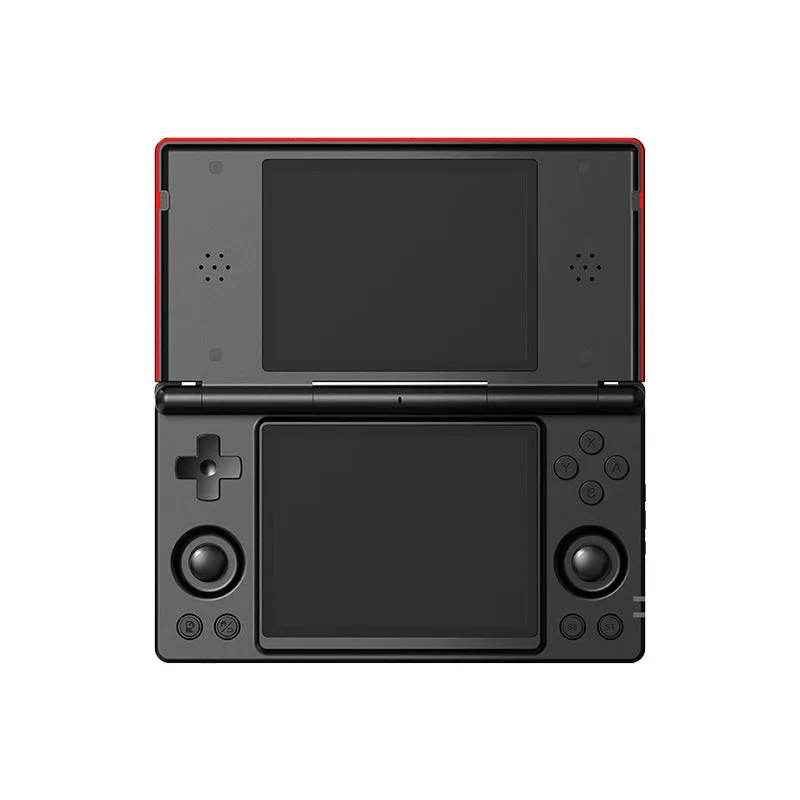
The RG DS is the odd one out: instead of one screen, it has two 4 inch IPS touch screens, both 640 x 480, with capacitive stylus support. The maker's page talks about the cover and a Hall switch chip that sleeps the unit when the cover is closed.
Stated specs: RK3568 quad-core Cortex-A55 up to 2.0 GHz, Android 14 / Linux 64-bit (the maker does not say how the two are chosen), a 4000 mAh battery and 6 hours of battery life, Wi-Fi on 2.4 and 5 GHz, Bluetooth 4.2 and a card slot supporting up to 2 TB. The maker's spec line reads 3+32GB without labelling which is RAM; we read it as 3 GB of RAM and 32 GB of storage.
It weighs 321 g and measures 16 x 9.1 x 2.15 cm, the largest and heaviest of the small clamshells. The maker lists $94.99 (checked October 2026). The maker names no systems, only Android games and more than 20 kinds of simulator.
The Miyoo Flip V2 is described by its maker as a compact, lightweight clamshell with an upgraded hinge, and the maker lists all-metal hinges. It lists a 3.5 inch IPS screen at 640 x 480, an RK3566 chip, a 3000 mAh Li-Po battery, dual joysticks, HDMI output and OTG support, with over 30 emulators named only as a count.
The page gives no RAM, Wi-Fi, Bluetooth, operating system or weight, and no battery life in hours, and it does not describe lid sensing. Pricing is split by variant: the maker's lowest figure is $64.99 for the no-card versions, the 64GB card versions are $69.99 and the regular price is $89.99 (checked October 2026, currency stated as USD). The gaps are the main thing to weigh before ordering.
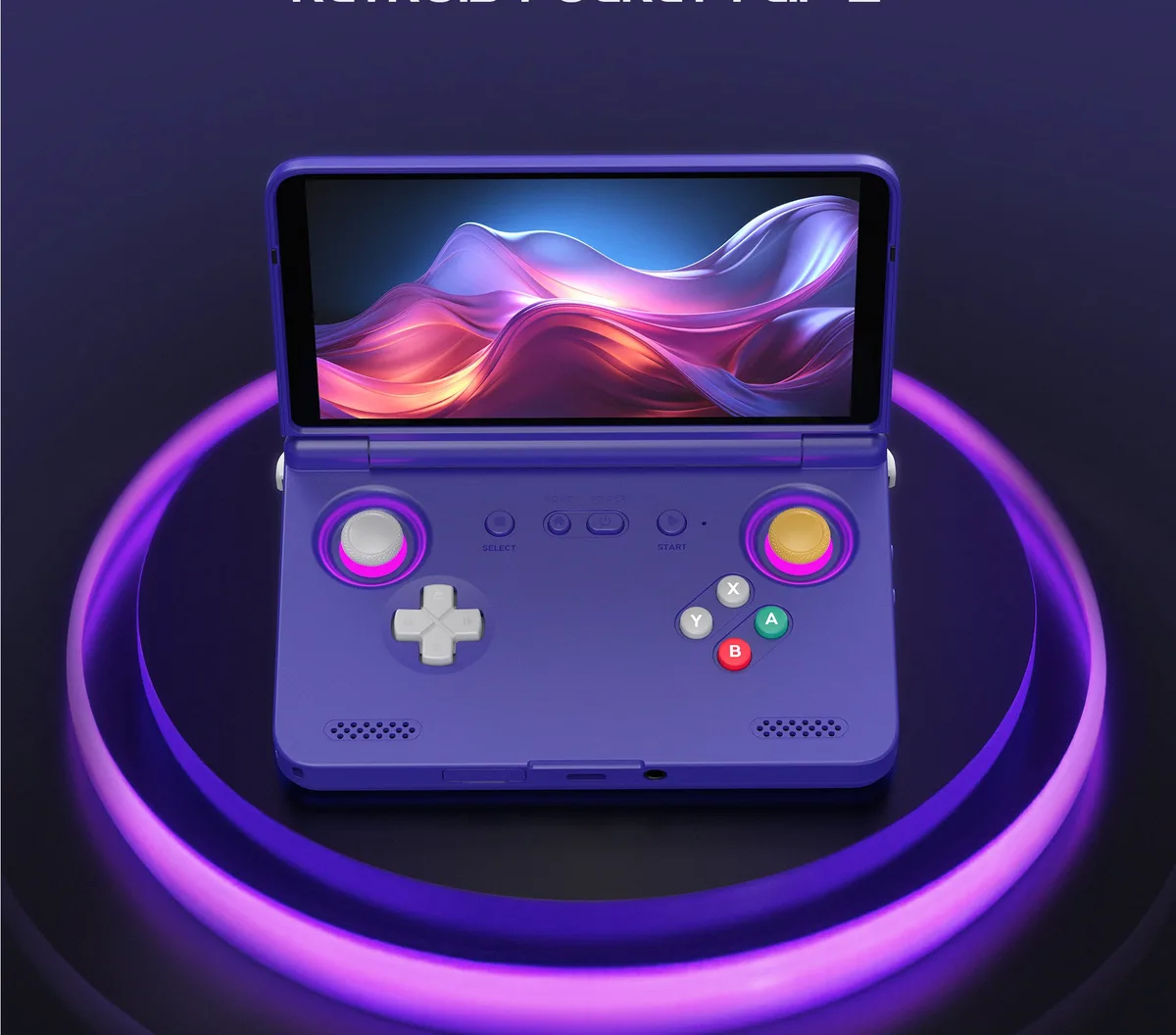
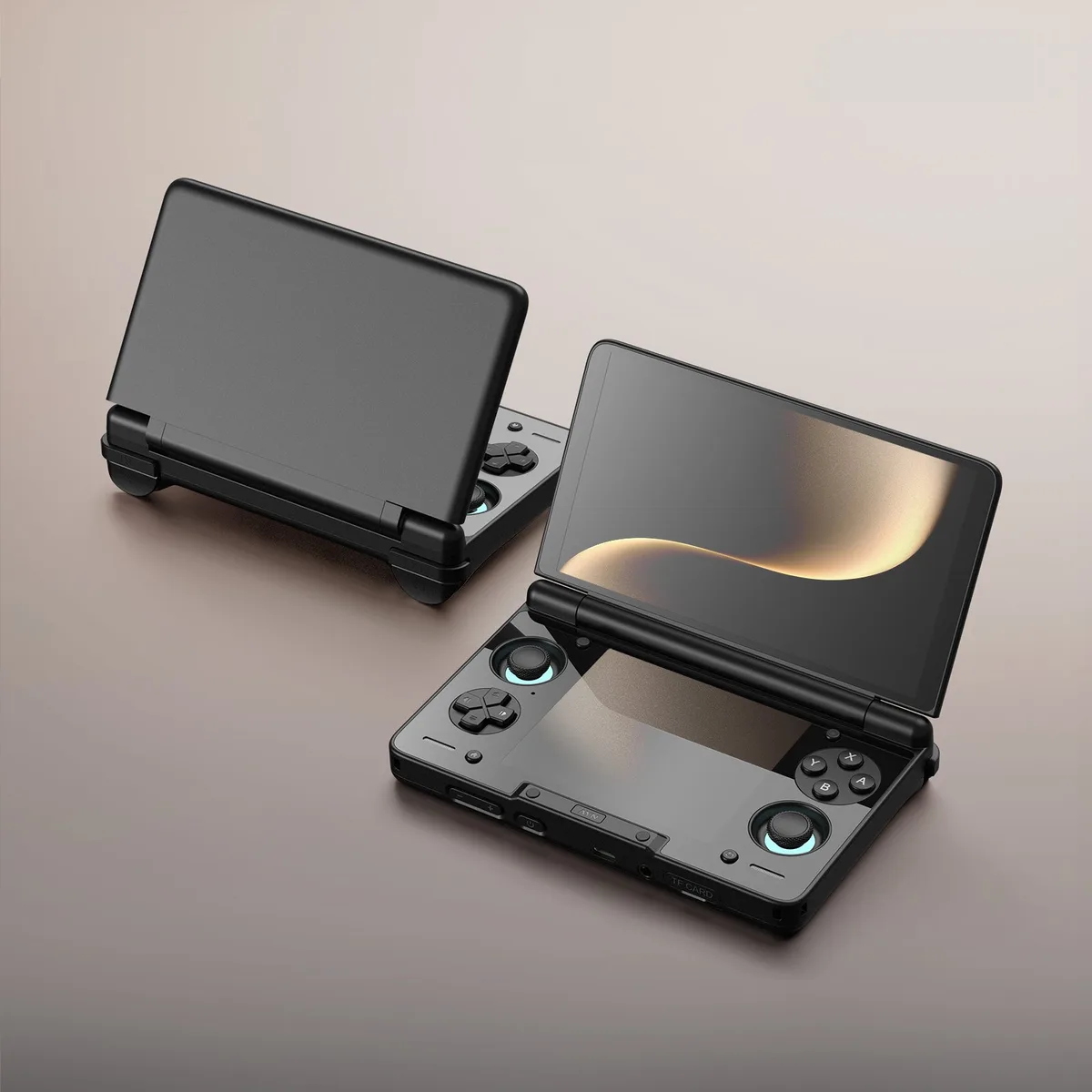
The Retroid Pocket Flip 2 and the AYN Thor are sometimes grouped with clamshells, but neither maker's page text describes a hinge, a fold or a lid, so we do not count them above. The Flip 2 page uses the word only in the product name.
For reference, the Flip 2 lists a 5.5 inch AMOLED at 1080p and 60 fps, an SD865 chip, Android 13, a 5000 mAh battery and active cooling, with 306 g and 140.5 x 89.5 x 24.4 mm from the spec image and $189 for the SD865 version (checked October 2026). The Thor lists a 6 inch AMOLED main screen plus a 3.92 inch AMOLED touch display, a 6000 mAh battery, Android 13, 380 g and 150 x 94 x 25.6 mm from the spec image, and a headline price of $259 that varies by version (checked October 2026). The Thor is a pre-order page. See Retroid Pocket Flip 2 vs AYN Thor for the stated figures side by side.
Makers rarely give hinge ratings or cycle counts, and none of these pages do. What the pages do give is the lid-sensing method: the Anbernic pages describe a Hall switch (a magnetic sensor) that sleeps the device when the lid or cover closes. The Miyoo page does not state lid sensing, so we cannot say whether closing the lid pauses the game there.
The Anbernic models list IPS with full lamination (the RG35XX SP and RG34XXSP pages also list full viewing angle), and the Miyoo lists a 3.5 inch IPS. For the difference between panels, see our explainer on IPS, OLED and LCD screens.
The two SP-style Anbernic models list footprints under 9 cm on each side and under 200 g. The RG DS is 16 cm long and 321 g. The Miyoo page states neither weight nor dimensions.
Compare stated hours, not just mAh. The maker hours are 8 (RG35XX SP), 6 (RG34XXSP) and 6 (RG DS); Miyoo gives none. Our battery explainer covers what the figures mean.
Card arrangements differ. The RG35XX SP and RG34XXSP each list dual TF slots with a 64GB card included and expansion up to 512GB. The RG DS lists 32GB built in plus a TF slot up to 2TB, and its box contents list a stylus and screen protector but no card. The Miyoo Flip V2 lists variants with a 64GB card or without one, and a TF slot. Both SP-style Anbernic models list 5V/1.5A charging and say they support a C2C charger. Our microSD card guide covers choosing a card.
We did not include the Ayaneo Pocket DS, because we could not establish its form factor from the maker's page text. We also left out the Miyoo Mini Plus, which is covered in our vertical handhelds guide. For the full catalogue, see our retro handhelds hub, or the UK buying guide, which covers eight devices from entry to flagship.
Anbernic
3.5 in IPS, full viewing angle, OCA full lamination · 3300 mAh · Linux 64-bit
UK price not checked
Anbernic
3.4 in IPS, full viewing angle, OCA full lamination · 3300 mAh · Linux 64-bit
UK price not checked
Anbernic
4 in IPS, OCA full lamination, multi-touch, supports capacitive stylus (two screens) · 4000 mAh · Android 14/Linux 64-bit
UK price not checked
AYN
Pre-order6 in Customized Full HD AMOLED touch screen (main); 3.92" AMOLED touch display (bottom) · 6000 mAh · Android 13
UK price not checked
Guides
Decodes the chip names makers list on retro handhelds, explains our entry, mid, high and flagship tiers, and says what those tiers cannot tell you.
8 min read
Guides
What the card does in a retro handheld, what makers state about slots and maximum sizes, and what the SD Association capacity and speed labels mean.
7 min read
Guides
Compares the IPS, OLED and LCD labels across 34 retro handhelds, with stated sizes and resolutions and pixel density worked out from the maker's figures. It does not explain how the panel types work.
7 min read