Best Retro Handhelds for GBA: 3:2 and 4:3 Screens Compared
Which retro handhelds suit Game Boy Advance games? We compare 3:2 and 4:3 screens, size, weight and stated battery, from maker figures only.
By Sepehr Sabbagh-pourPublished 14 Oct 2026Updated 9 Nov 202610 min read
For Game Boy Advance games the catalogue splits three ways: 3:2 screens on the Anbernic RG34XX, RG34XXSP and Powkiddy V10, 4:3 screens on the RG35XX family and both Miyoo models, and the Analogue Pocket, which plays original cartridges. Few makers name GBA, so this guide compares screens, size, weight and stated battery.
It works only from what makers state: screen size, resolution, battery, size and weight, and which systems they name. We have not played anything on these devices (see how we research), and we do not name individual games.
The two screen ratios in this guide are 3:2 and 4:3. Aspect ratio is the width divided by the height. We work the ratios out ourselves from each maker's stated resolution, because the pages mostly do not print a ratio, and the makers do not state how their devices scale a picture, so this guide compares screens only.
How the screens line up
| Device | Stated screen | Ratio (worked out) | Pixel density (worked out) | Systems the maker names |
|---|---|---|---|---|
| Powkiddy V10 | 3.5 inch IPS, 480 x 320 | 3:2 | about 165 ppi | GBA among a list of ten labels |
| Anbernic RG34XX / RG34XXSP | 3.4 inch IPS, 720 x 480 | 3:2 | about 255 ppi | None named |
| Anbernic RG35XX Plus / H / SP | 3.5 inch IPS, 640 x 480 | 4:3 | about 229 ppi | None named |
| Miyoo Mini Plus | 3.5 inch IPS, 640 x 480 | 4:3 | about 229 ppi | NES, SNES, GBA |
| Miyoo A30 | 2.8 inch IPS, 640 x 480 | 4:3 | about 286 ppi | NES, SNES, GBA, Game Boy |
| Analogue Pocket | 3.5 inch LCD, 1600 x 1440 | 10:9 | 615 ppi (maker) | Game Boy, Game Boy Color, GBA (cartridges) |
The pixel-density column is our arithmetic from the stated resolution and diagonal, apart from the Analogue figure, which the maker states. The ratio column is also ours.
What the 3:2 and 4:3 figures mean
A 640 x 480 screen is 4:3. A 720 x 480 screen is exactly 3:2, and a 480 x 320 screen is also exactly 3:2. As arithmetic only: a 3:2 picture shown at full width on a 640 x 480 screen would be 640 wide and about 427 tall, leaving about 53 pixel rows of bar in total, roughly 27 above and 27 below. That is a calculation from the stated figures, not a claim that any device looks better in use.
The same sum runs the other way. A 4:3 picture shown at full height on a 720 x 480 screen would be 640 wide, leaving 80 columns of bar in total, 40 on each side. On the 480 x 320 panel of the V10 it would be about 427 wide, leaving about 53 columns. A 3:2 screen therefore suits 3:2 pictures, a 4:3 screen suits 4:3 pictures, and each shows bars for the other. Which ratio a given game uses is something to confirm for the game you care about, because the makers do not state it.
The Analogue Pocket is the odd one out. Its 1600 x 1440 screen is 10:9, so a 3:2 picture fitted to the full width would be 1600 wide and about 1067 tall, leaving about 373 rows of bar in total. For what it is worth, ModRetro lists a 160 x 144 screen for its Game Boy style device, and 1600 x 1440 is exactly ten times that in each direction. How the Pocket handles other pictures is for the maker to say, and its page is where to check.
Side by side: size, weight, battery and price
| Device | Size (maker) | Weight (maker) | Battery (maker) | RAM | Maker price (checked Oct 2026) |
|---|---|---|---|---|---|
| Analogue Pocket | Technical drawing only | Not stated | 4300 mAh, 6 to 10 hours | Not stated | $239.99 |
| Anbernic RG34XX | 14.46 x 8.18 x 2.48 cm | 188 g | 3500 mAh, 7 hours | 1 GB | $59.99 |
| Anbernic RG34XXSP | 8.3 x 8.2 x 2.5 cm | 178 g | 3300 mAh, 6 hours | 1 GB | $67.99 |
| Powkiddy V10 | 103.2 x 94 x 22.5 mm | Not stated | 3000 mAh, 8 hours | 1 GB | $39.99, sold out |
| Anbernic RG35XX SP | 8.9 x 8.5 x 2.7 cm | 192 g | 3300 mAh, 8 hours | 1 GB | $57.99 |
| Anbernic RG35XX Plus | 11.7 x 8.1 x 2.2 cm | 186 g | 3300 mAh, 8 hours | 1 GB | $49.99, sold out |
| Anbernic RG35XX H | 14.5 x 6.9 x 1.6 cm | 180 g | 3300 mAh, 8 hours | 1 GB | $57.99 |
| Miyoo A30 | Not stated | Not stated | 2600 mAh, hours not stated | 512 MB | $52.99, sold out |
| Miyoo Mini Plus | Not stated | Not stated | 3000 mAh, hours not stated | Not stated | $58.99 |
Two readings from the table, both arithmetic. The Analogue Pocket's maker price is about four times the $57.99 shown for the RG35XX SP or H ($239.99 against $57.99, a gap of $182.00), which is the cost of original-cartridge play rather than a like-for-like upgrade. And the 720 x 480 panel on the RG34XX has 345,600 pixels against 307,200 on a 640 x 480 panel, 12.5 percent more, while the RG34XX states 7 hours against 8 for the RG35XX H. The makers give no reason for the difference in hours.
1. Analogue Pocket: best for original cartridges
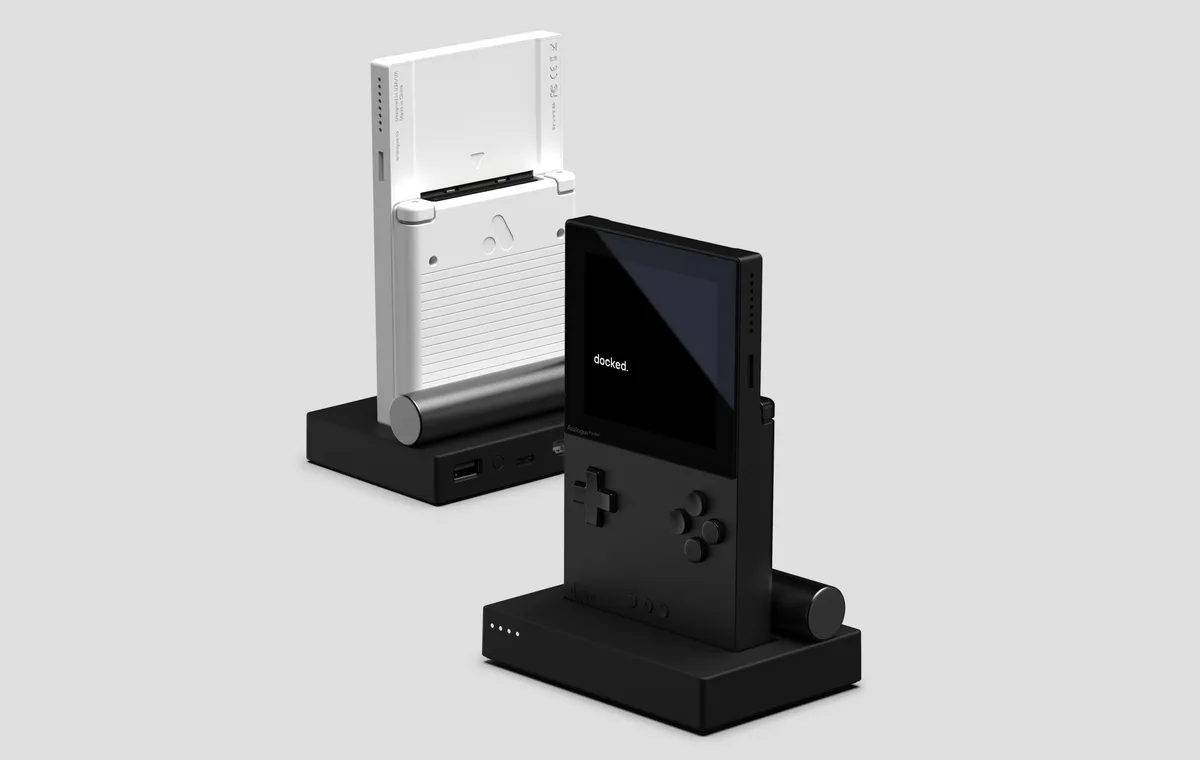
The Analogue Pocket works differently from everything else here. The maker says it plays original Game Boy, Game Boy Color and Game Boy Advance cartridges, engineered in FPGAs (programmable chips that recreate hardware) with no emulation. That means you bring your own cartridges, and the maker quotes a library figure of 2,780+ games. Adapters sold separately add other cartridge types, and the dock is listed with 1080p HDMI output and two USB inputs.
It lists a 3.5 inch LCD at 1600 x 1440, 615 ppi, behind Gorilla Glass, a 4300 mAh battery and 6 to 10 hours of gameplay (6 hours is described as a rough estimate at default brightness). The maker gives weight and size only as a technical drawing, so neither is stated here. The screen works out to 10:9, which is not 3:2 or 4:3, so check how the maker handles scaling before assuming bars. The maker lists $239.99 (checked October 2026); its availability wording has changed since, so confirm stock and the UK price with the maker. Our Analogue Pocket vs RG35XX SP page sets it against a budget alternative.
2. Anbernic RG34XX: best for a 3:2 screen
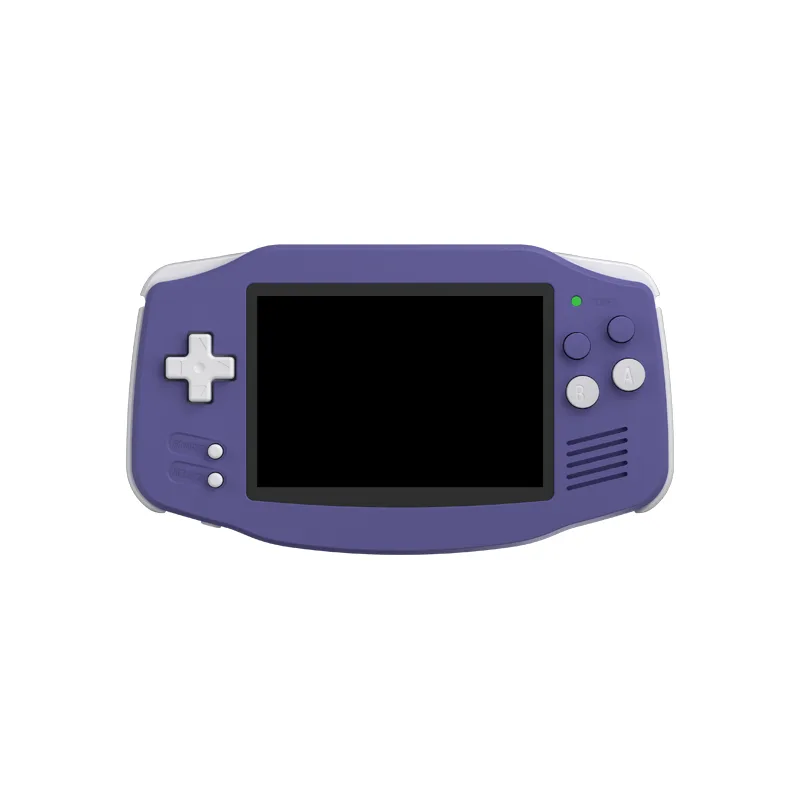
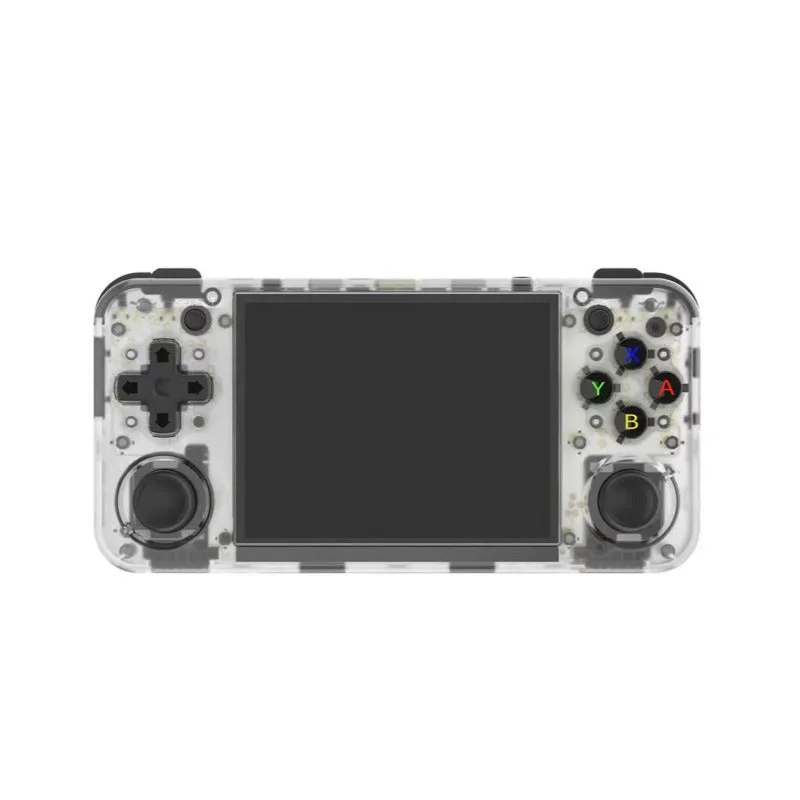
The RG34XX has a 3.4 inch IPS screen at 720 x 480, which we work out as exactly 3:2. The maker lists an H700 quad-core chip at 1.5 GHz, 1 GB of RAM, a 3500 mAh battery and 7 hours of battery life, dual TF slots, 802.11ac Wi-Fi and Bluetooth 4.2, running 64-bit Linux. It weighs 188 g and measures 14.46 x 8.18 x 2.48 cm. The maker names no systems, only ported games and more than 30 emulators, so confirm what you need with Anbernic. The maker lists $59.99 as a sale price, with $69.99 as the regular price (checked October 2026).
3. Anbernic RG34XXSP: best for a 3:2 screen that folds
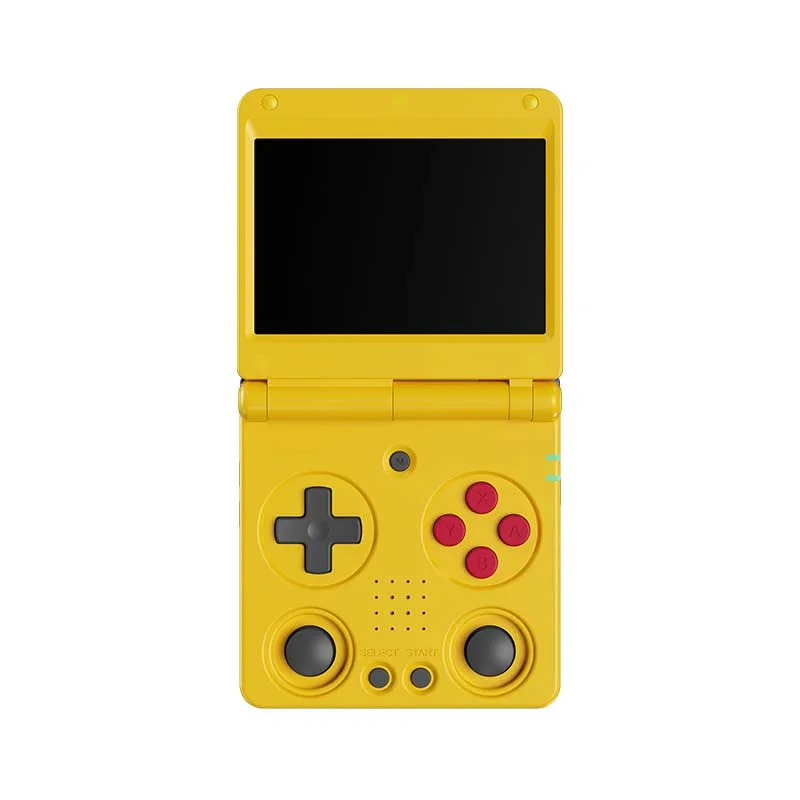
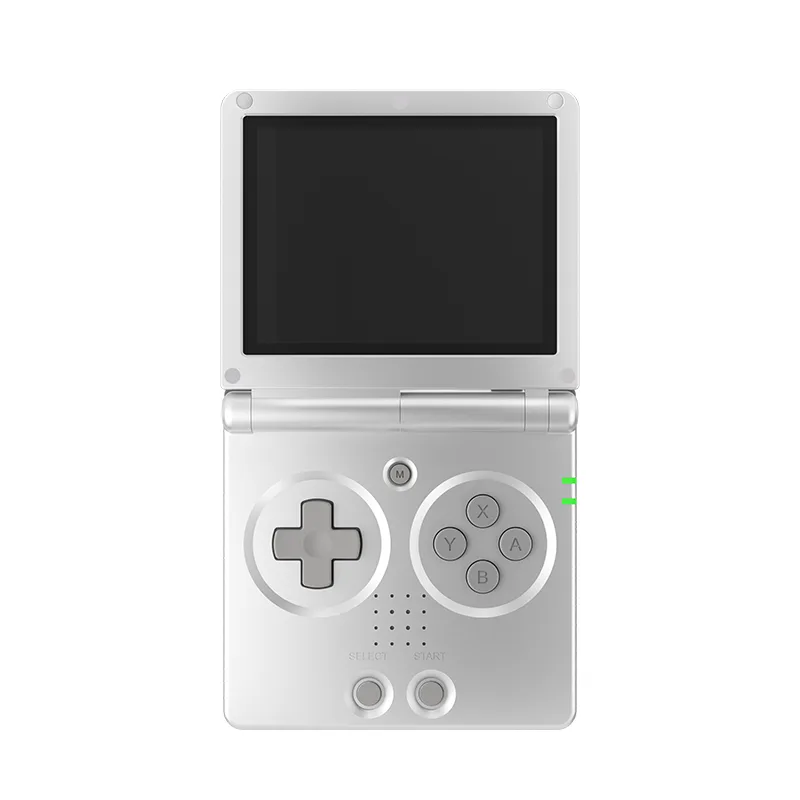
The RG34XXSP takes the same 720 x 480 panel and the same chip into a clamshell body, with a Hall switch that sleeps the device when the lid closes. It is 178 g, listed at 8.3 x 8.2 x 2.5 cm, with a 3300 mAh battery and 6 hours stated. It lists $67.99 (checked October 2026). See our clamshell guide for the other folding models.
4. Powkiddy V10: best for a small 3:2 panel
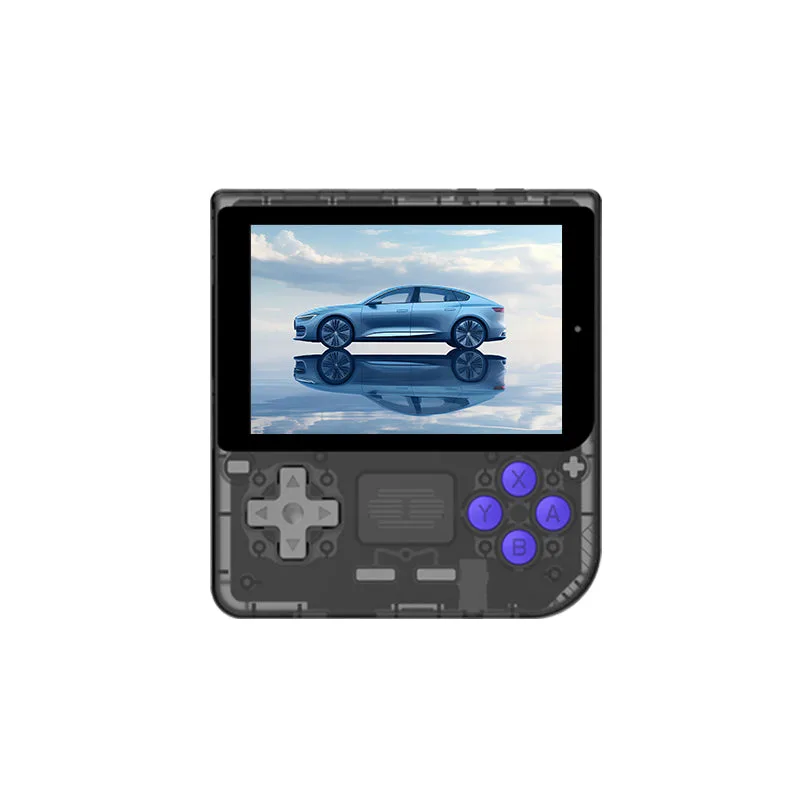
The Powkiddy V10 is the other 3:2 device: a 3.5 inch IPS screen at 480 x 320. At about 165 ppi by our arithmetic it has the lowest pixel density in the list. The maker lists a quad-core Cortex-A35 at 1.5 GHz, 1 GB of DDR3L RAM and a 3000 mAh battery with 8 hours stated, in a body of 103.2 x 94 x 22.5 mm. Weight and Bluetooth are not stated and Wi-Fi is listed as external. Its system list includes GBA among ten labels. The maker lists $39.99 (checked October 2026), and its page showed every variant sold out when checked.
5. Anbernic RG35XX SP: best for 4:3 in a clamshell
The RG35XX SP uses a 3.5 inch IPS screen at 640 x 480 in a lid-and-base body of 192 g. It lists 8 hours stated from 3300 mAh, dual TF slots and an H700 chip with 1 GB of RAM. The maker lists a $57.99 sale price (checked October 2026). The same screen and chip appear in the RG35XX Plus (186 g, $49.99, sold out when checked) and the RG35XX H (180 g, $57.99), both with 8 hours stated. Our RG35XX SP vs RG34XXSP page compares the SP with the 3:2 model.
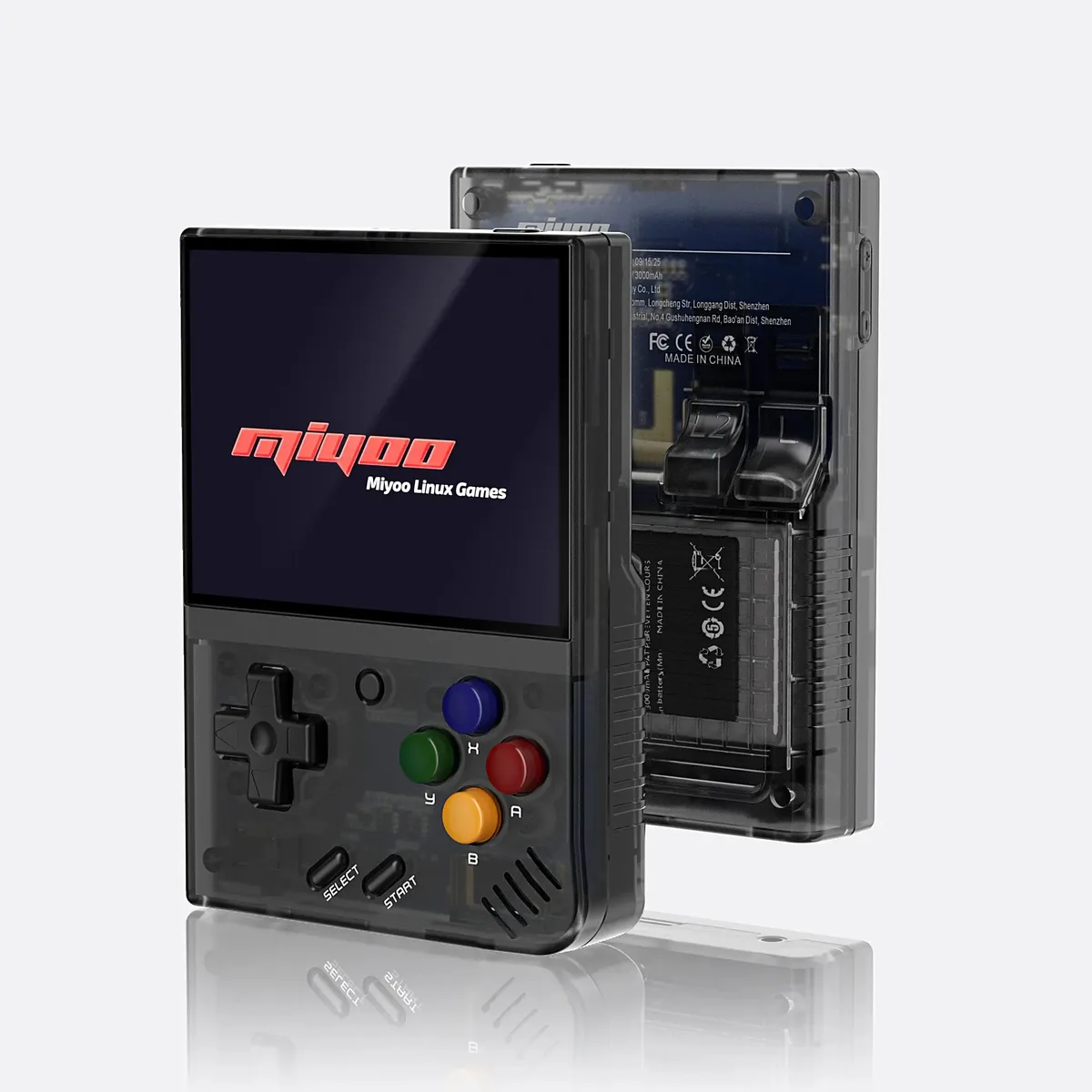
6. Miyoo A30: best for a small, GBA-named device
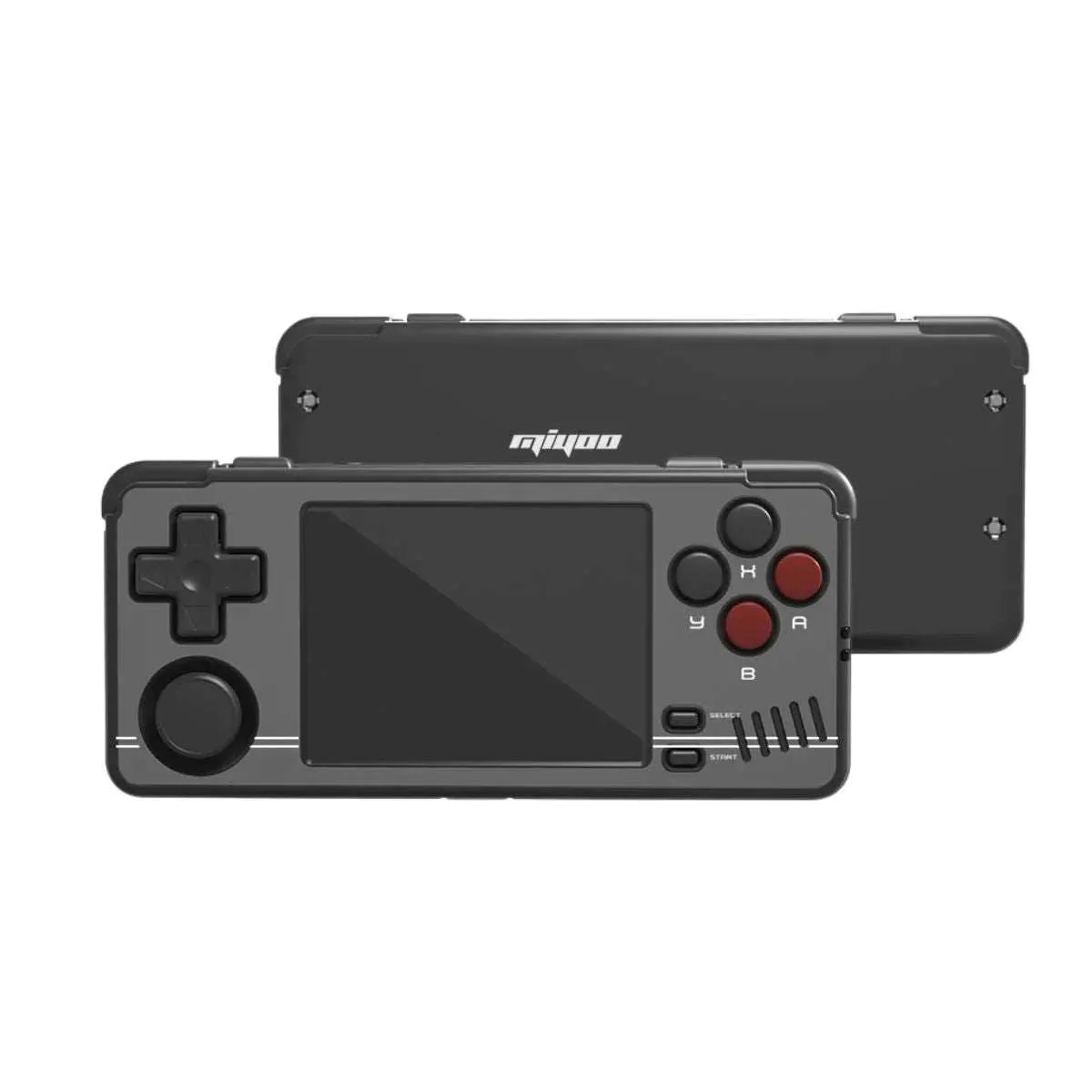
The Miyoo A30 is the smallest screen here at 2.8 inches, still 640 x 480 (about 286 ppi, our arithmetic). The maker names NES, SNES, GBA and Game Boy, and lists an Allwinner A33 quad-core, 512 MB of RAM, a 2600 mAh battery and built-in 2.4 GHz Wi-Fi. The page does not state weight, dimensions or Bluetooth, and showed it as sold out, limited quantities. The maker lists $52.99 in US dollars (checked October 2026).
7. Miyoo Mini Plus: best for the upright shape
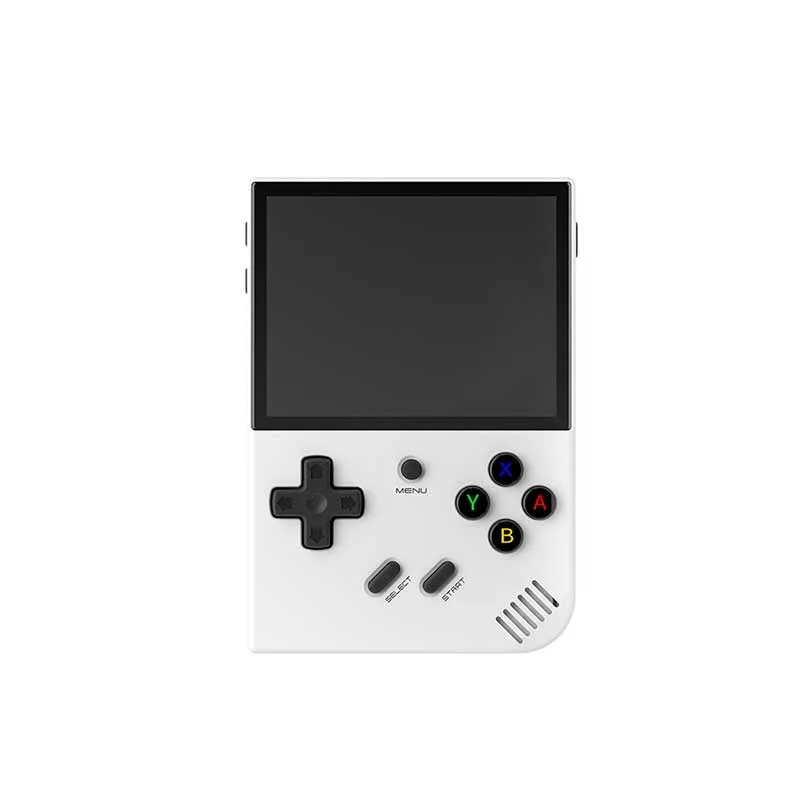
The Miyoo Mini Plus has a 3.5 inch 640 x 480 IPS screen, a 3000 mAh battery and built-in Wi-Fi, and the maker names NES, SNES and GBA. RAM, weight, size and battery hours are not stated. It lists $58.99 (checked October 2026). Its upright design is covered in our vertical handhelds guide.
Who should skip which device
- Skip the Analogue Pocket if you have no original cartridges or need a device now, because the UK price and delivery are not checked.
- Skip the V10 if pixel density matters to you, since at about 165 ppi it is the lowest here, or if you need a stated weight or Bluetooth, which the maker does not give.
- Skip the Miyoo pair if you want stated weight, size or battery hours for planning; the maker gives none. The A30 also shows 512 MB of RAM, the lowest stated figure in the list.
- Skip the Anbernic models if you need the maker to name GBA before you buy; the pages say 30+ emulators and name no system.
What to check before you buy
- What the maker names. Only the Miyoo pair, the Powkiddy V10 and the Analogue Pocket name Game Boy Advance on their pages. For the Anbernic models the maker says 30+ emulators without listing them, so ask before you buy if a specific system matters.
- Screen shape. 3:2 for the 34XX pair and V10, 4:3 for the rest, 10:9 for the Analogue Pocket. See how to read handheld specs for the ratio sums.
- Size and weight. The Anbernic 3.4 to 3.5 inch models weigh 178 to 192 g. The Miyoo, Powkiddy V10 and Analogue pages state no weight.
- Battery. Compare stated hours: 8 for the RG35XX models and V10, 7 for the RG34XX, 6 for the RG34XXSP and 6 to 10 for the Analogue. The Miyoo pages state none. See battery life explained.
- Stock. The RG35XX Plus, A30 and V10 pages showed sold out when checked.
- Cost beyond the sticker. Every price here is a maker dollar figure with no UK price, delivery time or import VAT checked, so add those before comparing against a UK shop price.
How to choose
Pick the Analogue Pocket only if you own original cartridges and accept a maker dollar price that is several times the Anbernic figures. Pick the RG34XX or RG34XXSP if you want a 3:2 screen; pick the V10 if you would trade pixel density for price (its page showed every variant sold out when checked). Pick a 4:3 Anbernic if you want a 640 x 480 screen at a low maker price, or the Miyoo Mini Plus or A30 (shown as sold out when checked) if you want a maker that names NES, SNES and GBA. For the broader field, see the best retro handhelds guide and the full catalogue.
Devices in this guide
Anbernic
Anbernic RG34XX
3.4 in IPS, OCA full lamination · 3500 mAh · Linux 64-bit
UK price not checked
Anbernic
Anbernic RG34XXSP
3.4 in IPS, full viewing angle, OCA full lamination · 3300 mAh · Linux 64-bit
UK price not checked
Powkiddy
Sold outPowkiddy V10
3.5 in IPS OCA full lamination · 3000 mAh · Various open source Linux
UK price not checked
Anbernic
Anbernic RG35XX SP
3.5 in IPS, full viewing angle, OCA full lamination · 3300 mAh · Linux 64-bit
UK price not checked
Anbernic
Sold outAnbernic RG35XX Plus
3.5 in IPS, OCA full lamination · 3300 mAh · Linux 64-bit
UK price not checked
Anbernic
Anbernic RG35XX H
3.5 in IPS, OCA full lamination · 3300 mAh · Linux 64-bit
UK price not checked
Frequently asked questions
- What screen ratio suits Game Boy Advance games?
- The makers do not state a ratio, so we work it out from the resolutions. In the catalogue the Anbernic RG34XX and RG34XXSP (720 x 480) and the Powkiddy V10 (480 x 320) are exactly 3:2, while the RG35XX family and both Miyoo models are 640 x 480, which is 4:3. The Analogue Pocket works out to 10:9. Which ratio a particular game uses is not stated by any of the makers, so confirm it for the games you care about before choosing a screen shape.
- How big are the bars if a 3:2 picture is shown on a 640 x 480 screen?
- At full width a 3:2 picture would be about 427 pixels tall on a 480-pixel-high 4:3 screen, leaving about 53 rows of bar in total, roughly 27 above and 27 below. Run the other way, a 4:3 picture at full height on a 720 x 480 screen would be 640 wide, leaving 80 columns of bar, 40 on each side. This is arithmetic from the stated resolutions, not a measurement, and the makers do not state how their devices scale a picture.
- Does the Analogue Pocket use emulation?
- The maker says it is engineered in FPGAs, which are programmable chips that recreate hardware, with no emulation, and that it plays original Game Boy, Game Boy Color and Game Boy Advance cartridges. You therefore need your own cartridges, and the maker quotes a library figure of 2,780+ games. It lists $239.99 (checked October 2026) and the availability wording has changed since, so confirm availability and the UK price with the maker.
- Which GBA handheld has the longest stated battery life?
- The Analogue Pocket states 6 to 10 hours from 4300 mAh, and describes 6 hours as a rough estimate at default brightness. The Anbernic RG35XX Plus, H and SP and the Powkiddy V10 each state 8 hours, the RG34XX states 7 and the RG34XXSP states 6. The Miyoo pages state no hours. None of the makers explains how its figure was measured, so use the hours to compare devices on paper and not to plan a trip.
- Which of these is smallest?
- The Miyoo A30 has the smallest screen at 2.8 inches, but its maker states no weight or size. Of the devices with stated weights, the Anbernic RG34XXSP is lightest at 178 g, followed by the RG35XX H at 180 g and the RG35XX Plus at 186 g. By stated footprint the RG34XXSP (8.3 x 8.2 cm) and the RG35XX SP (8.9 x 8.5 cm) are the most compact because they fold. The Analogue Pocket gives size only as a drawing.
Sources
More from Guides
Guides
Retro handheld chips explained: H700, Snapdragon and more
Decodes the chip names makers list on retro handhelds, explains our entry, mid, high and flagship tiers, and says what those tiers cannot tell you.
8 min read
Guides
microSD cards for retro handhelds: sizes, classes and slots
What the card does in a retro handheld, what makers state about slots and maximum sizes, and what the SD Association capacity and speed labels mean.
7 min read
Guides
IPS vs OLED vs LCD retro handheld screens: stated labels and figures
Compares the IPS, OLED and LCD labels across 34 retro handhelds, with stated sizes and resolutions and pixel density worked out from the maker's figures. It does not explain how the panel types work.
7 min read