Valve
Valve Steam Deck OLED
7.4 in HDR OLED, 1280 x 800, up to 90Hz · SteamOS 3 (Arch-based)
UK price not checked
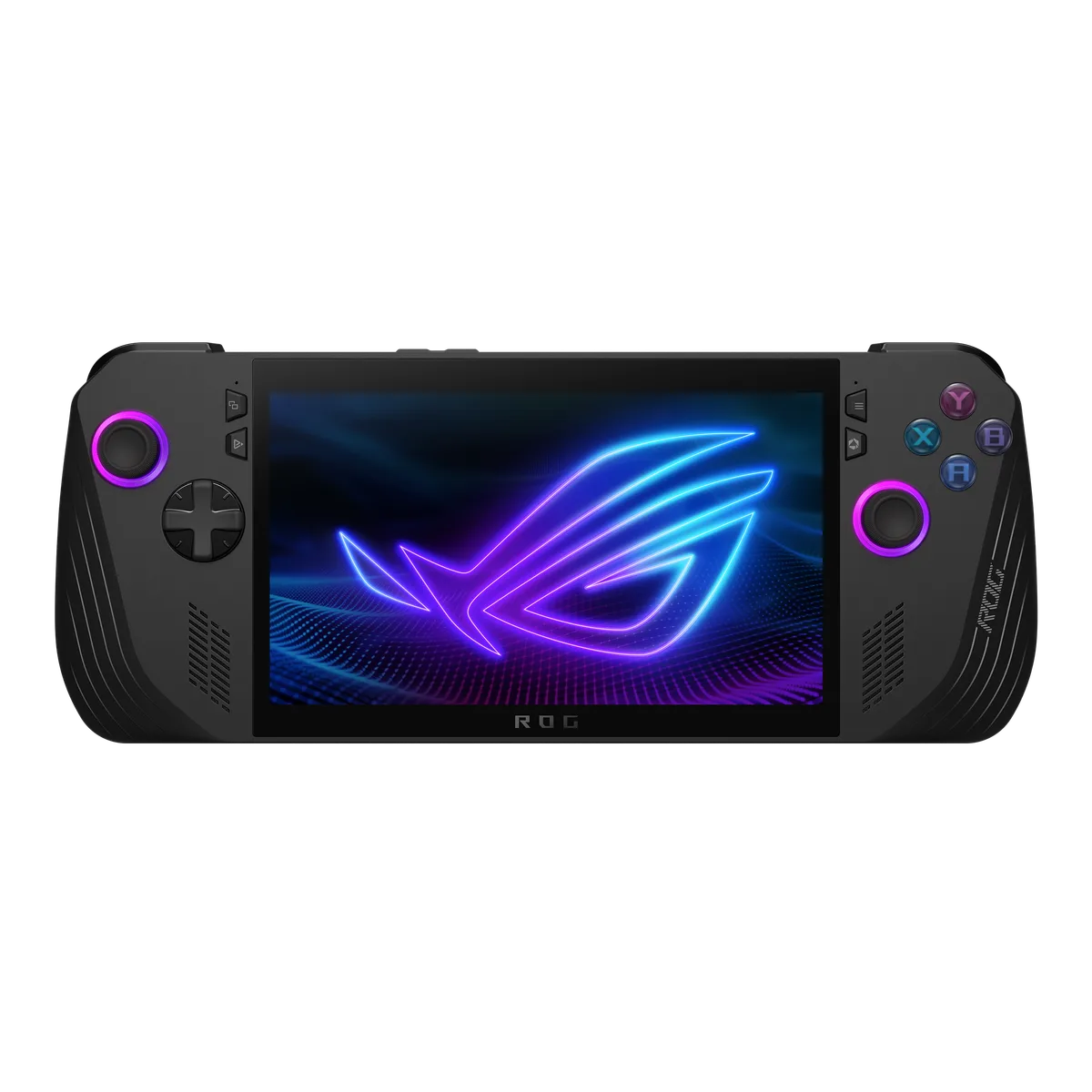
The Steam Deck OLED lists SteamOS, a 7.4 inch OLED and 640 g; the ROG Ally X lists Windows 11, a 7 inch 1080p 120Hz panel and an 80Wh battery.
By Sepehr Sabbagh-pourPublished 16 Oct 2026Updated 9 Nov 20267 min read

Choose the Steam Deck OLED for Valve's SteamOS 3, a 7.4 inch HDR OLED and the lighter body (640 g). Choose the ROG Ally X for Windows 11 Home, a 1920 x 1080 screen at 120Hz and an 80Wh battery. Figures are the makers' own, recorded in October 2026; we have not tested either device.
| Stated figure | Valve Steam Deck OLED | ASUS ROG Ally X |
|---|---|---|
| Operating system | SteamOS 3 (Arch-based), KDE Plasma desktop | Windows 11 Home |
| Chip | 6 nm AMD APU, Zen 2 | AMD Ryzen Z1 Extreme, Zen 4, 4nm |
| CPU cores and threads | 4 cores, 8 threads, 2.4 to 3.5GHz | 8 cores, 16 threads, up to 5.10 GHz boost |
| Graphics | 8 RDNA 2 CUs at 1.6GHz, 1.6 TFlops FP32 | 12 RDNA 3 CUs, up to 2.7 GHz, up to 8.6 Teraflops |
| Power range | APU power 4 to 15W | TDP 9 to 30W |
| RAM | 16 GB LPDDR5, 6400 MT/s | 24GB LPDDR5, dual channel |
| Storage | 512GB or 1TB NVMe SSD | 1TB PCIe 4.0 NVMe SSD |
| Card slot | microSD, UHS-I | microSD, UHS-II |
| Screen | 7.4 inch HDR OLED, 1280 x 800, up to 90Hz | 7 inch IPS-level, 1920 x 1080, 120Hz |
| Brightness | 1,000 nits peak (HDR), 600 nits (SDR) | 500 nits |
| Battery | 50Wh, 3 to 12 hours (maker, content dependent) | 80Wh, hours not stated |
| Weight | 640 g | 678 g |
| Dimensions | 298 x 117 x 49 mm | 280 x 111 x 24.7 to 36.9 mm |
| Wi-Fi and Bluetooth | Wi-Fi 6E, Bluetooth 5.3 | Wi-Fi 6E, Bluetooth 5.4 |
| Charger | 45W USB-C supply with a 2.5m cable | 65W Type-C adapter (inclusion varies by country and model) |
| Maker price (checked Oct 2026) | £779 for the 512GB OLED | Not shown: price label with no amount |
Valve's own page and ASUS's own page are the only sources behind this table (see how we research). Where a cell says a figure is not stated, the maker is silent, and we have not filled the gap from memory or from reviews.
This is the clearest split. Valve lists SteamOS 3 and a KDE Plasma desktop and does not list Windows for the device. ASUS lists Windows 11 Home, with Armoury Crate and Command Center buttons among the controls. What each system means for your library is a personal question; SteamOS vs Windows on handheld PCs sets out only what the makers state.
One practical consequence follows from the wording alone. ASUS says the Bluetooth version on the Ally X may change with the OS version, so a Windows machine's spec line can depend on the software build. Valve's page gives one operating system and one version number for Bluetooth, 5.3.
On paper the ROG Ally X lists more: 8 cores and 16 threads against 4 and 8, and 24GB of RAM against 16 GB. That is 8GB, or 50 percent, more memory by the stated figures. Valve and ASUS both state a power range (4 to 15W and 9 to 30W respectively), which is a power rating for the chip, not a measure of speed.
Be careful with the graphics row. Valve gives 1.6 TFlops FP32 and ASUS gives up to 8.6 Teraflops, and the two pages do not say the figures were calculated the same way. We use those numbers to show what each maker publishes, not to rank the two chips, and we make no claim about frame rates. For definitions, see handheld PC chips explained.
The two screens trade on different lines. Valve states a larger 7.4 inch OLED with HDR and 1,000 nits peak, but at 1280 x 800 and up to 90Hz. ASUS states a 7 inch panel at 1920 x 1080 and 120Hz, IPS-level, with 500 nits, FreeSync Premium and Gorilla Glass Victus. ASUS also states 100% sRGB coverage; Valve gives no colour-gamut figure on the pages recorded.
Higher resolution means more pixels on the same area. From the stated figures, 1280 x 800 is 1,024,000 pixels and 1920 x 1080 is 2,073,600, roughly double. Spread over the stated diagonals, that works out at about 204 pixels per inch on the Deck and about 315 on the Ally X. These are our own arithmetic from the makers' numbers, not maker claims. OLED and IPS are panel types, compared in IPS vs OLED vs LCD screens.
The Deck's 1280 x 800 grid is 16:10, while the Ally X's 1920 x 1080 grid is 16:9. A widescreen 16:9 picture at the Deck's full 1280 pixel width is 720 pixels tall, leaving 80 rows spare, so 40 rows of black above and below if it is not stretched. On the Ally X a 16:9 picture fills the panel exactly. Older 4:3 pictures leave side bars on both: at full height, 4:3 is 1067 pixels wide on the Deck (1280 minus 1067 leaves about 213 columns, roughly 107 each side) and 1440 pixels wide on the Ally X (480 columns spare, 240 each side). This is arithmetic only; how a given game scales is not something either maker states.
The Ally X lists 80Wh, the Steam Deck OLED 50Wh. A larger watt-hour figure means more stored energy on paper, but Valve is the only one that states hours (3 to 12, content dependent), so no like-for-like runtime comparison is possible from the makers' pages. Dividing Valve's 50Wh by its own 12 and 3 hours gives an implied average draw of about 4 to 17W across that range, which shows how wide a content-dependent claim can be.
The Deck is 38 g lighter (640 g against 678 g) and thicker at its deepest listed point (49 mm against 36.9 mm). It is also longer, at 298 mm against 280 mm, and 6 mm wider (117 mm against 111 mm). The Ally X's 80Wh in 678 g works out at about 0.118 Wh per gram, against about 0.078 for the Deck's 50Wh in 640 g, so the Ally X lists 30Wh more battery in a body that is 38 g heavier overall. See battery life explained for why stated figures need care.
Both list tri-band Wi-Fi 6E and a microSD slot. The Deck lists Bluetooth 5.3 and a UHS-I card slot; the Ally X lists Bluetooth 5.4 (ASUS notes the version may change with the OS version) and a UHS-II reader, plus a USB 4 Type-C port it says is Thunderbolt 4 compliant. Card basics are in microSD cards.
On internal storage, Valve offers 512GB or 1TB for the OLED, while ASUS lists a single 1TB PCIe 4.0 drive. If you expect to install large libraries, the stated gap is 512GB against 1TB at the lower Deck tier, and both devices accept a card to add more.
Valve lists 298 x 117 x 49 mm, two full-size thumbsticks with capacitive touch, two 32.5mm trackpads, four assignable grip buttons and a 6-axis IMU. ASUS lists 280 x 111 x 24.7 to 36.9 mm and names Armoury Crate and Command Center buttons among its controls, but gives no thumbstick or trackpad detail, so the controls cannot be compared line by line. For ports, ASUS lists a 3.5mm combo jack, a USB 3.2 Gen 2 Type-C and a USB 4 Type-C; the Valve entry we recorded gives a 45W USB-C supply but no port list, so port counts cannot be compared.
Valve's UK pages show £779 (checked Oct 2026) for the 512GB OLED, though the same page says the OLED starts at £649, a figure that sits beside the 256GB LCD model. The ASUS spec page shows a price label but no amount, so we cannot compare prices. UK prices should be confirmed on each maker's store.
For more options, see best PC handhelds in the UK, the PC handheld articles and guides. New to the category? Read what a handheld gaming PC is. Our editorial policy explains how we handle prices and corrections.
Valve
7.4 in HDR OLED, 1280 x 800, up to 90Hz · SteamOS 3 (Arch-based)
UK price not checked
ASUS
7 in 7-inch FHD (1920 x 1080) IPS-level touchscreen, 120Hz · Windows 11 Home
UK price not checked
PC Handhelds
The chips in six handheld PCs, as the makers state them: cores, threads, boost speed, graphics and power range, with no performance claims.
7 min read
PC Handhelds
Valve lists SteamOS 3 on the Steam Deck OLED; ASUS and MSI list Windows 11 Home; Lenovo describes both. Here is what each maker says.
8 min read
PC Handhelds
A handheld gaming PC is a portable computer with built-in controls, running a full PC operating system. Here is how that differs from retro handhelds and consoles.
8 min read